


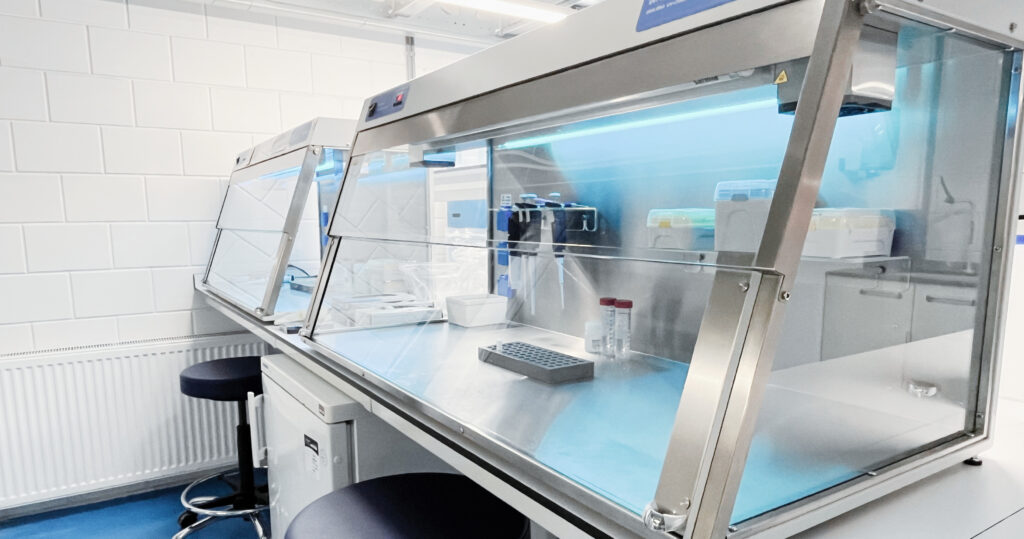
eDNA service lab
By commissioning Sylphium to carry out your eDNA analyses, your organisation receives reliable results without requiring in-house expertise in molecular ecology. You collect the samples and send them to Sylphium’s laboratory for analysis. All analyses are validated, published, and performed in accordance with strict quality assurance rules based on NPR 7394. A complete list of target species is available here.
Sylphium has developed a proprietary sampling system designed to enable consistent and highly reliable sample collection while minimising the risk of contamination. The core of this system is the eDNA Dual Filter Capsule. Dedicated sampling materials are also available for soil and droppings. All materials are designed to meet the requirements of NPR 7394.
Roadmap for eDNA research
| Step | Description | Performed by |
|---|---|---|
| 1 | Choose type of eDNA research | Client (in consultation with Sylphium) |
| 2 | Sampling strategy | Client (in consultation with Sylphium) |
| 3 | Sampling | Client |
| 4 | Sending samples to laboratory | Client |
| 5 | Analysis | Sylphium |
| 6 | Preparation of analysis report | Sylphium |
| 7 | Final report | Client |
Choosing the right type of eDNA research
Several DNA-based methods can detect species quickly, reliably, and with high sensitivity. The table below helps determine which method best fits your research question.
| Species-specific detecion | Species identification | Species list (metabarcoding) | |
|---|---|---|---|
| Description | Detect a specific target species, quantitatively or qualitatively, with very high sensitivity. | Identify a species based on material from a single individual. | Semi-quantitatively generate a species list of the most common species within a group. |
| Suitable for | Fish, amphibians, mammals, reptiles, invertebrates, pathogens, plants, bacteria. | Fish, amphibians, mammals, reptiles, and larger invertebrates. | Fish, bacteria, and eukaryotes. |
| Sample type | Water, soil, tissue residues, and faeces. | Tissue residues and faeces. | Water, soil, and faeces. |
| Analysis | qPCR | Barcoding | Metabarcoding |
| Lead time | Within 10 working days (urgent possible) | Approx. 14 working days | Approx. 3 months (often faster possible) |
Sampling strategy
Sylphium’s eDNA analyses achieve the highest possible sensitivity (1 molecule per analysis). Therefore, sampling has the greatest impact on detection probability. For maximum detection probability, correct sample registration, and prevention of cross-contamination, follow the eDNA sampling guidelines and the manual of the sampling set.
Sampling
Water, faeces, and soil can be sampled to demonstrate specific target species or to determine species composition. Sylphium has dedicated sampling kits for each sample type. After sampling, samples are stored in a special buffer and can be kept at room temperature.
Sending samples to the laboratory
Samples can be sent to our laboratory using any postal or courier service. We recommend using a trackable shipping method and avoiding shipment immediately before the weekend. Please send the samples to:
Sylphium molecular ecology
Diamantlaan 6B
9743 BG Groningen
The Netherlands
Clearly state your sample or project reference on the shipment and inform us once the samples have been dispatched.
Analysis
- eDNA extraction: extraction of clean eDNA for reliable downstream analysis
- Quality control: internal positive control DNA in the preservation buffer verifies sample quality, extraction efficiency, and potential inhibitors
- Target species analysis: a wide range of validated eDNA tests, available as kits and as a service; all analyses follow strict NPR-based quality standards.
Report
The results are presented in a clear report, including all validation and quality control information. Click here for an example.